
County Rules
Two Materials Worth Keeping Clean
These are the two materials where twenty minutes of discipline on site shows up directly on the invoice.
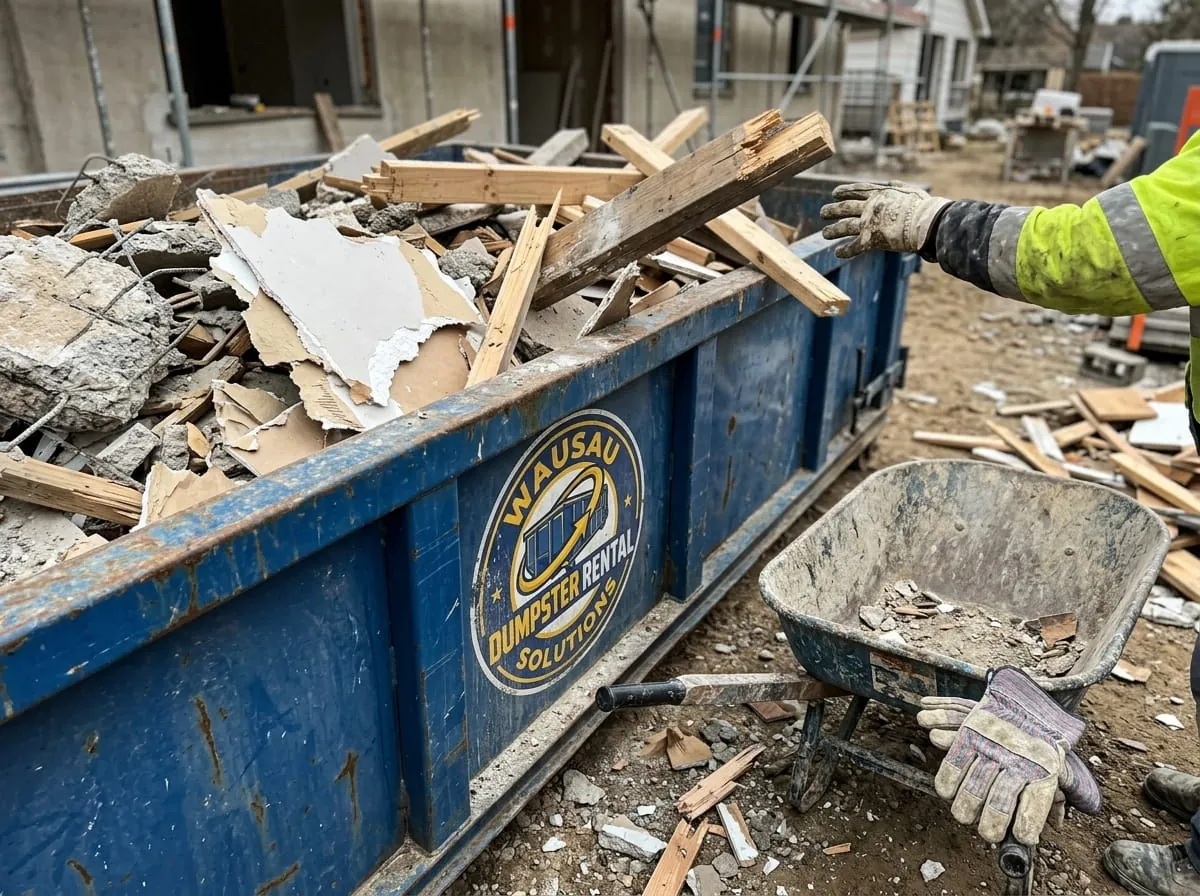
Why these two in particular
Marathon County publishes rates for a long list of materials. Two of them matter more than the rest for anyone renting a container, because they are heavy, they come in large quantities, and they each have a cheap dedicated rate that a mixed load forfeits entirely.
Concrete and asphalt shingles. Get them right and a demolition or a re-roof costs noticeably less. Get them wrong and you pay the landfill rate on several tons of the densest material on the job.
⭐ What counts as clean concrete
The county's definition is specific and more generous than people assume:
- No tar
- No paint
- No coatings
- ⭐ Rebar is acceptable
That last point is the one worth knowing. People routinely assume reinforcement disqualifies a load and spend an afternoon trying to cut it out. You do not need to. A reinforced slab, broken up with the steel still in it, is clean concrete as far as the rate is concerned.
What qualifies alongside it in practice: broken slab, footings, block, brick, and masonry rubble — the ordinary output of taking out a driveway, a patio, a foundation wall or a chimney.
⚠️ And the logistics note: loads of 15 yards or more need a call ahead. That is not a small load, but a decent-sized driveway removal reaches it.
⚠️ What ruins a concrete load
Usually not the concrete. It is the things that come off the slab with it:
- Sealed or painted surfaces. A garage floor with a coating on it, a painted patio, an epoxy-sealed basement slab.
- Bitumen or tar bonded to the underside, common where a slab was laid over old asphalt.
- The soil and sod that comes up with footings. Dirt is not concrete, and it is extraordinarily heavy in its own right.
- Timber forms, plastic sheeting and insulation pulled out at the same time.
- Wire mesh with the timber still attached to it.
⚠️ Note that clean asphalt has its own separate rate too, higher than concrete. So if you are taking out both a concrete slab and an asphalt drive, they are two clean streams, not one — and mixing them is not the same thing as contaminating either.
⭐ Clean shingles and the tear-off
Residential asphalt shingles, non-asbestos, have their own per-ton rate. For a re-roof that is a meaningful saving, because a single-layer tear-off on an ordinary house runs to a couple of tons and a multi-layer one considerably more.
What belongs in a clean shingle load:
- Asphalt shingles
- Roofing felt and underlayment
- Nails, which are unavoidable and expected
⚠️ Non-asbestos is doing real work in that sentence. Older roofing products can contain asbestos, and asbestos-containing material is a separate process requiring 24 hours' notice. It never goes in a container. If the roof is old enough to raise the question, test before the tear-off starts rather than during.
⚠️ What contaminates a shingle load
This is the expensive list, because every item on it is something a roofer naturally throws into the same container:
- Flashing, drip edge and vents — metal, and metal is free to drop separately
- Fascia, soffit and trim taken off at the same time
- Rotten decking replaced during the job
- Packaging from the new bundles — cardboard, which is banned from Wisconsin landfills anyway
- Gutters, which are metal again
- ⚠️ Commercial membrane roofing, which the county does not accept with shingles at all
Look at that list for a moment: the metal on it is free to dispose of separately, and the cardboard on it is banned from landfill. So the same discipline that protects the shingle rate also routes two other streams correctly. None of this is extra work; it is the same work done in a sensible order.
Both are heavy, which is the point
Rate differences only matter when there is tonnage behind them, and these two materials have more than almost anything else a homeowner handles.
- Concrete is about as dense as debris gets. A 10 yard container part-filled with broken slab can weigh more than a 30 yard of household contents.
- Shingles are deceptive. A tear-off looks like a modest pile and weighs a great deal, which is why roofing jobs hit a container's weight allowance long before they fill it.
So for both, size down. A part-filled 10 yard of clean concrete is the right answer, not a 20 that cannot legally be lifted. And a roofing container should be sized for the weight allowance, not for how much room the shingles appear to take up. More on sizing here.
How we set the job up
Tell us at the quote that you want the clean rate and we will arrange the job around it:
- Separate containers where the volumes justify it — a small one for the clean stream and a general one for everything else.
- A staged swap where they do not. Concrete first, collected, then the general debris. One container, two loads, two rates.
- A clear instruction to the crew about what must not go in. Most contamination is somebody being helpful at four in the afternoon.
- Metal staged separately on the ground, because it is free to drop and it is coming out either way.
We will also tell you when it is not worth it, which is the next section.
When keeping it clean is not worth it
Three cases, honestly:
- Very small quantities. Half a barrow of broken concrete in a general renovation load is not worth a second container or a staged swap. Put it in and move on.
- When the concrete genuinely is contaminated and cleaning it is impractical — a coated garage slab, for instance. Chasing the rate by chipping coatings off is not a good use of a weekend.
- When the schedule will not take a swap. If the job has to be done in one day and a staged collection would stall it, the labor cost of the delay can exceed the disposal saving.
The rule of thumb: if the clean stream is more than a ton or so and it can be kept separate without slowing the work, separate it. Below that, or if it would cost you a day, do not.
County rates and conditions change. The above reflects Marathon County's published rate sheet at the time of writing. Confirm current rates and acceptance conditions before planning a large job around them.
Need a container in Wausau?
Call and describe the job. Three minutes on the phone gets you a size recommendation, a flat rate and a delivery window — and we will tell you if a smaller, cheaper container is the right answer.
Call (715) 814-9498